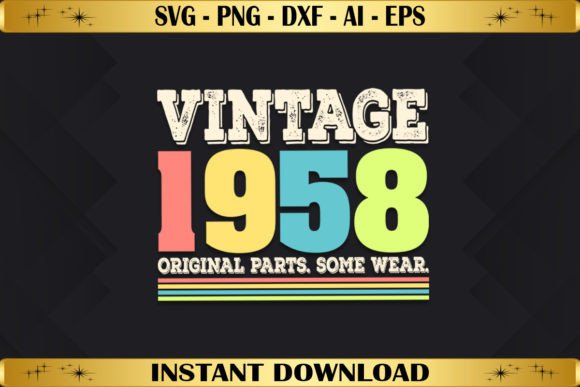
Vintage 1958 Original Parts Birthday Design Review
As a professional embroidery digitizer and product reviewer, I approach every new graphic asset with a specific question: will this actually stitch out cleanly on fabric? When evaluating the Vintage 1958 Original Parts Birthday design, my primary focus is translating a digital vector concept into a tangible, high-quality embroidered product. This review breaks down the practical realities of using this specific artwork for custom apparel, personalized gifts, and commercial merchandise from the perspective of someone who runs an embroidery machine daily.
First Impressions and Visual Personality
The Vintage 1958 Original Parts Birthday carries a distinct retro industrial aesthetic that immediately signals nostalgia. Visually, it balances bold typography with mechanical iconography, creating a masculine yet celebratory mood. For an embroidery designer, this layout is promising because it typically relies on clear shapes rather than intricate gradients. The "Original Parts" theme suggests a blocky, structured font style which generally translates well to satin stitches or dense fill stitches. However, the vintage distressing often found in these graphics requires careful interpretation during the digitizing process. If the source file contains too much grunge texture, it can result in excessive jump stitches or thread breaks. As a T-shirt design, it has strong visual hierarchy, but as an embroidery project, we must ensure the distressed elements are simplified into clean stitch paths to maintain structural integrity on fabric.
Real-World Application: The Custom Sweatshirt Test
To truly evaluate this asset, I mentally applied it to a real-life scenario: creating a custom 66th birthday sweatshirt for a client’s father. Sweatshirts are a staple for Etsy sellers and small shop owners, but fleece presents unique challenges due to its pile and stretch. In this context, the Vintage 1958 Original Parts Birthday serves as an excellent centerpiece for chest or back placement. The bold nature of the "1958" numerals allows for adequate stitch density without becoming bulletproof. When stitching this on fleece, the design needs to sit on top of the fabric texture rather than sinking in. I would utilize a heavy-weight cutaway stabilizer and potentially a water-soluble topping to prevent the fleece pile from poking through the lettering. This specific use case highlights why having the original AI and EPS files is crucial; they allow me to thicken thin lines or simplify internal details before generating the final embroidery file, ensuring the vintage look remains legible after washing.
Performance Across Different Substrates
Beyond sweatshirts, this design shows versatility for various handmade products. For tote bag designs, the graphic holds up exceptionally well on canvas because the stable weave supports dense stitching without distortion. However, when considering baby embroidery or lightweight tea towels, caution is necessary. The "Original Parts" motif implies a certain weight; if stitched too densely on thin cotton, it could cause puckering or fabric tearing. For lighter items, I recommend modifying the design to use running stitches or lighter fill patterns. Conversely, for embroidered patches or caps, the bold geometry of the 1958 text is ideal. Caps require designs that accommodate curvature, and the horizontal orientation of this birthday theme fits naturally within the limited vertical space of a hat frame. Always verify your hoop size against the design dimensions before committing to curved surfaces.
Critical Considerations for Stitch Quality
While the Vintage 1958 Original Parts Birthday is visually appealing, there are specific technical constraints to watch for. Small text is the enemy of clean embroidery. If the design includes sub-text like "Limited Edition" or fine decorative lines under 2mm, these may need to be removed or resized for machine embroidery. Tiny details that look crisp in a PNG print often become thread nests on fabric. Additionally, consider the contrast between thread colors and fabric background. Vintage palettes often include muted tones; ensure you test thread colors against dark fabrics to maintain readability. For commercial embroidery projects intended for frequent washing, such as aprons or kitchen linens, verify that all elements are securely anchored with appropriate underlay. A design that looks great on screen but lacks proper foundational stitching will unravel or distort after three laundry cycles, damaging customer trust in your finished product.
Navigating File Formats and Digitizing Potential
This product package includes SVG, PNG, DXF, AI, and EPS files. It is vital to understand that these are vector and raster graphics, not pre-digitized embroidery files like DST or PES. For craft business owners and apparel decorators, this is actually an advantage. It provides total control over the digitizing process. You can import the AI or EPS file directly into software like Wilcom, Hatch, or Brother PE-Design to create a custom machine embroidery design tailored to your specific fabric and hoop size. Do not attempt to auto-digitize the PNG file, as this often yields poor stitch paths. Instead, use the vector files to manually trace or reshape elements. This ensures the stitch direction flows logically, reducing production time and improving the drape of the final garment. Always check licensing terms within the zip folder to confirm whether you have rights for commercial embroidery sales versus personal use only.
Professional Workflow and Testing Protocols
Before listing any item featuring the Vintage 1958 Original Parts Birthday in your Etsy shop or boutique, implement a rigorous testing protocol. Never run a production piece without a sew-out on scrap fabric that matches your final substrate. Check for registration issues where different color blocks meet; vintage designs often have intentional gaps, but in embroidery, misalignment looks like an error. Evaluate the stitch density by feeling the back of the sample; if it feels stiff or cardboard-like, reduce the density settings. Test the design in both light and dark thread variations to see how the vintage shading translates. Furthermore, create printable mockups using the included high-resolution PNG to gauge market interest before investing hours in digitizing. This dual approach—validating both the digital presentation and the physical stitch quality—is what separates professional makers from hobbyists.
Enhancing Product Value Through Design Integrity
Ultimately, the success of a personalized gift or commercial apparel line depends on execution. The Vintage 1958 Original Parts Birthday offers a strong foundation for nostalgic merchandise, but its value is realized only through thoughtful adaptation. By respecting the limitations of thread and fabric, you transform a flat graphic into a premium tactile experience. Whether you are producing holiday embroidery for family reunions or stocking inventory for a craft fair, prioritize clarity over complexity. Ensure your stabilizer choice matches the fabric weight, confirm your needle size is appropriate for the thread type, and always inspect small corners for fraying. When customers receive a sweatshirt or tote where the vintage lettering is crisp, aligned, and soft to the touch, they recognize the craftsmanship. That attention to detail builds brand consistency and encourages repeat business far more effectively than the graphic alone ever could.